
Setting up a biogas plant in India is one of the most promising clean energy investments available today. With the Government of India's SATAT (Sustainable Alternative Towards Affordable Transportation) scheme providing assured offtake of Compressed Biogas (CBG), and agricultural waste available across rural India, the economics are compelling. But the single question every serious investor asks first is: what is the real biogas plant cost in India? The honest answer depends on your capacity, feedstock, site, technology route, and delivery model. This guide breaks down every cost component so you can assess your project with full clarity before committing capital.
What Is a Biogas Plant and Why Is CBG Important for India?
A biogas plant converts organic waste — agricultural residues, cow dung, food waste, municipal organics — into biogas through a biological process called anaerobic digestion. This biogas is then purified and compressed to produce CBG (Compressed Biogas) or BioCNG, which is chemically identical to CNG and can be sold directly to fuel stations, industries, or CGD (City Gas Distribution) networks.
CBG is not a future technology — it is operational today. Plants are running in Haryana, Karnataka, Maharashtra, Uttar Pradesh, and Kerala, converting agricultural and organic waste into clean commercial fuel.
- India generates over 500 million tonnes of agricultural residue annually — most of it wasted or burned in fields.
- The SATAT scheme has set a target of 5,000 CBG plants across India, with assured offtake by Oil Marketing Companies (OMCs).
- CBG qualifies for priority sector lending from banks, with concessional interest rates.
- Digestate — the plant's byproduct — can be sold as certified organic fertiliser (FOM/LFOM), creating an additional revenue stream.
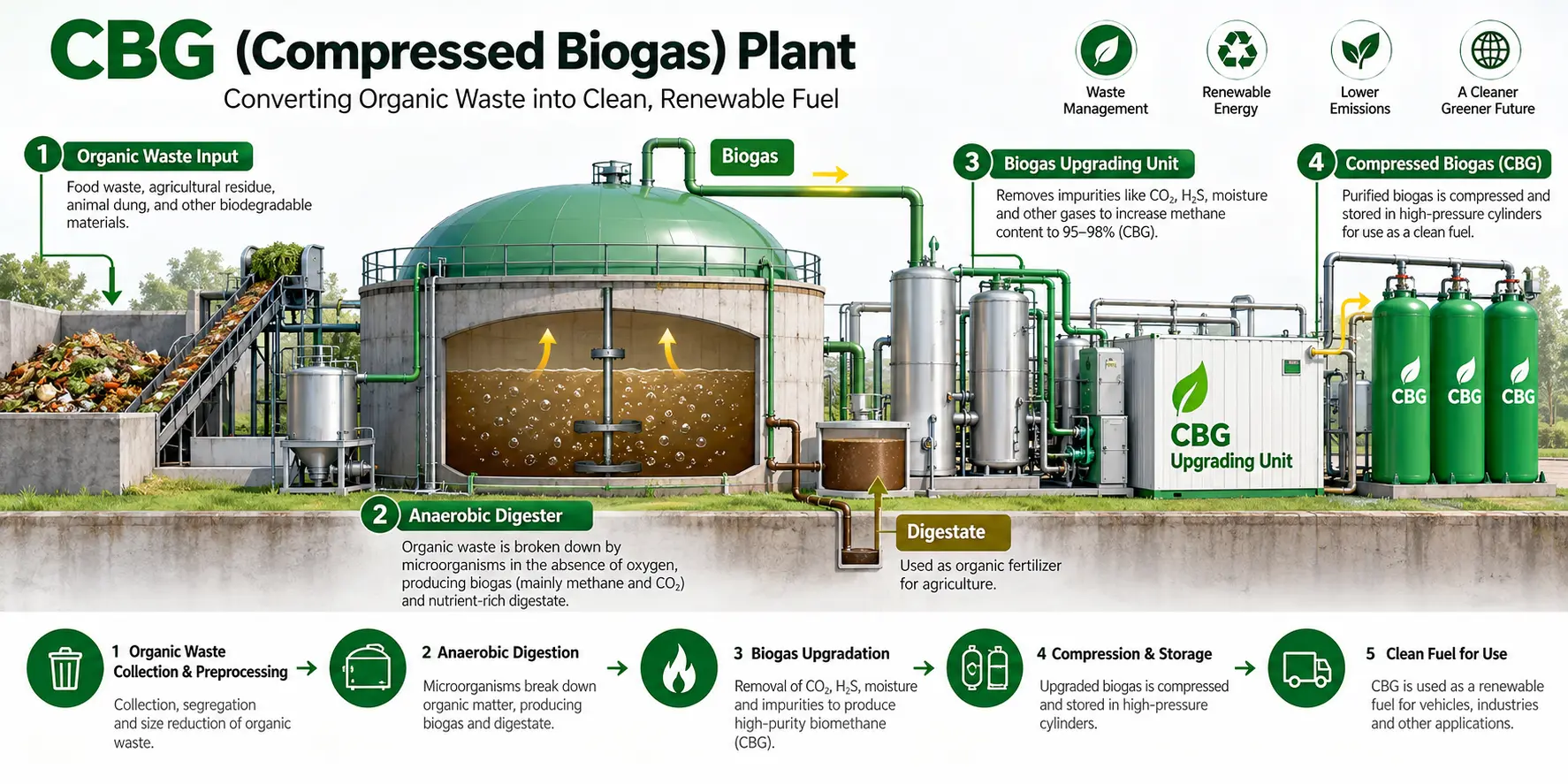
CBG connects waste management, renewable energy and clean-fuel infrastructure into a single circular energy ecosystem — making it one of the most complete investment opportunities in India's clean-energy transition.
Key Factors That Determine Biogas Plant Cost in India 2026
Biogas plant cost in India is not a fixed number. Five core factors determine your total project budget — and understanding each one is essential before any capital commitment is made.
1. Plant Capacity — Tonnes Per Day (TPD)
Plant size is the single largest cost driver. A 5 TPD plant and a 15 TPD plant do not cost three times more — they cost 1.5x–2x more due to economies of scale. Common commercial scales under the SATAT scheme range from 5 TPD to 100+ TPD feedstock input. The right capacity for your project must be determined by your feedstock availability — not the other way around.
2. Feedstock Type
Feedstock determines your digestion technology route — and your technology route determines your plant cost. High-solids crop residues such as paddy straw require dry digestion with higher civil cost and lower water consumption. Wet slurry feedstock such as cattle dung suits CSTR-based wet digestion with lower civil cost. Mixed feedstocks require a hybrid architecture with blend control, adding engineering complexity. Learn more about feedstock strategy and technology selection.
3. Site and Location
Land cost, water availability, grid connectivity, road access, and distance from feedstock sources all affect total project cost. A plant in Haryana with a 2 km feedstock collection radius costs very differently from the same plant in Kerala with a 10 km municipal collection route.
4. Delivery Model — EPCM vs LSTK
The choice between owner-managed EPCM and single-point-accountability LSTK affects both your total project budget and your risk exposure. EPCM gives owners cost visibility and procurement savings; LSTK transfers execution risk to the contractor at a fixed price. Compare EPCM and LSTK contract models in detail.
5. Technology Source and Equipment Origin
Imported European reactor technology carries better performance data and process guarantees but costs more upfront. India-manufactured equipment may reduce capital expenditure but requires careful technical evaluation. The right choice depends on your feedstock type, project scale, and risk tolerance.
Biogas Plant Cost in India — Component-Wise Breakdown
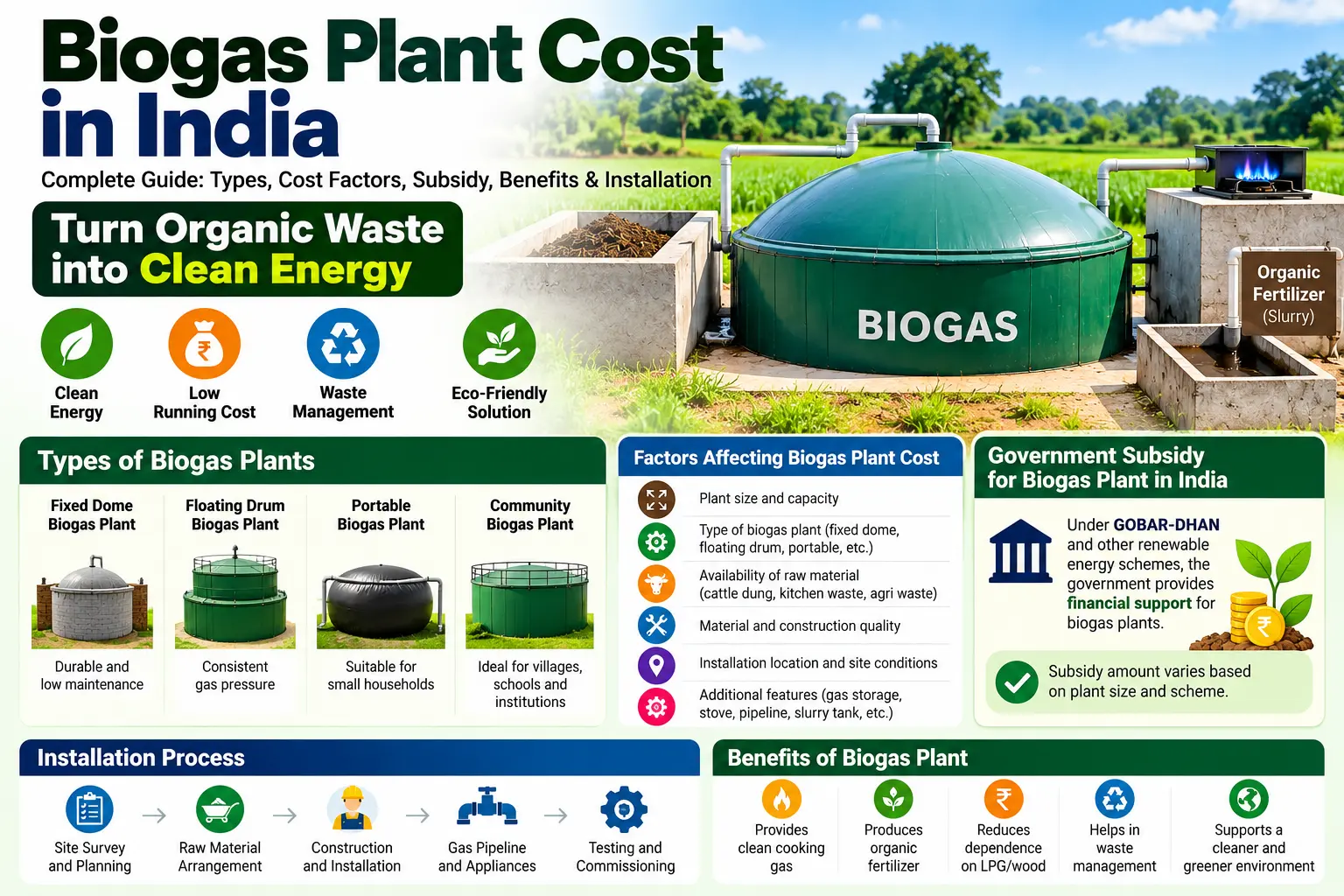
Biogas plant cost in India breaks into five major cost heads. Each component has its own sub-drivers and must be estimated individually for an accurate and bankable project budget.
Civil & Structural Works
Accounts for 25–35% of total cost. Covers digester construction, gas holder, feed reception area, slurry handling, digestate storage, plant roads, boundary wall, control room and utility infrastructure. Dry digestion plants carry higher civil costs due to reactor volume.
Equipment & Machinery
Accounts for 35–45% of total cost. Includes feed pretreatment systems, digester and mixing equipment, gas handling, H₂S scrubbing, gas upgrading (PSA/membrane/water scrubbing), compression and dispensing, and digestate management systems.
Engineering & Compliance
Accounts for 8–12% of total cost. Covers process design, detailed engineering, statutory approvals, environmental clearances, HSE compliance, quality systems and project controls. Often underestimated by first-time investors but critical to plant success.
Electrical, Instrumentation & Automation
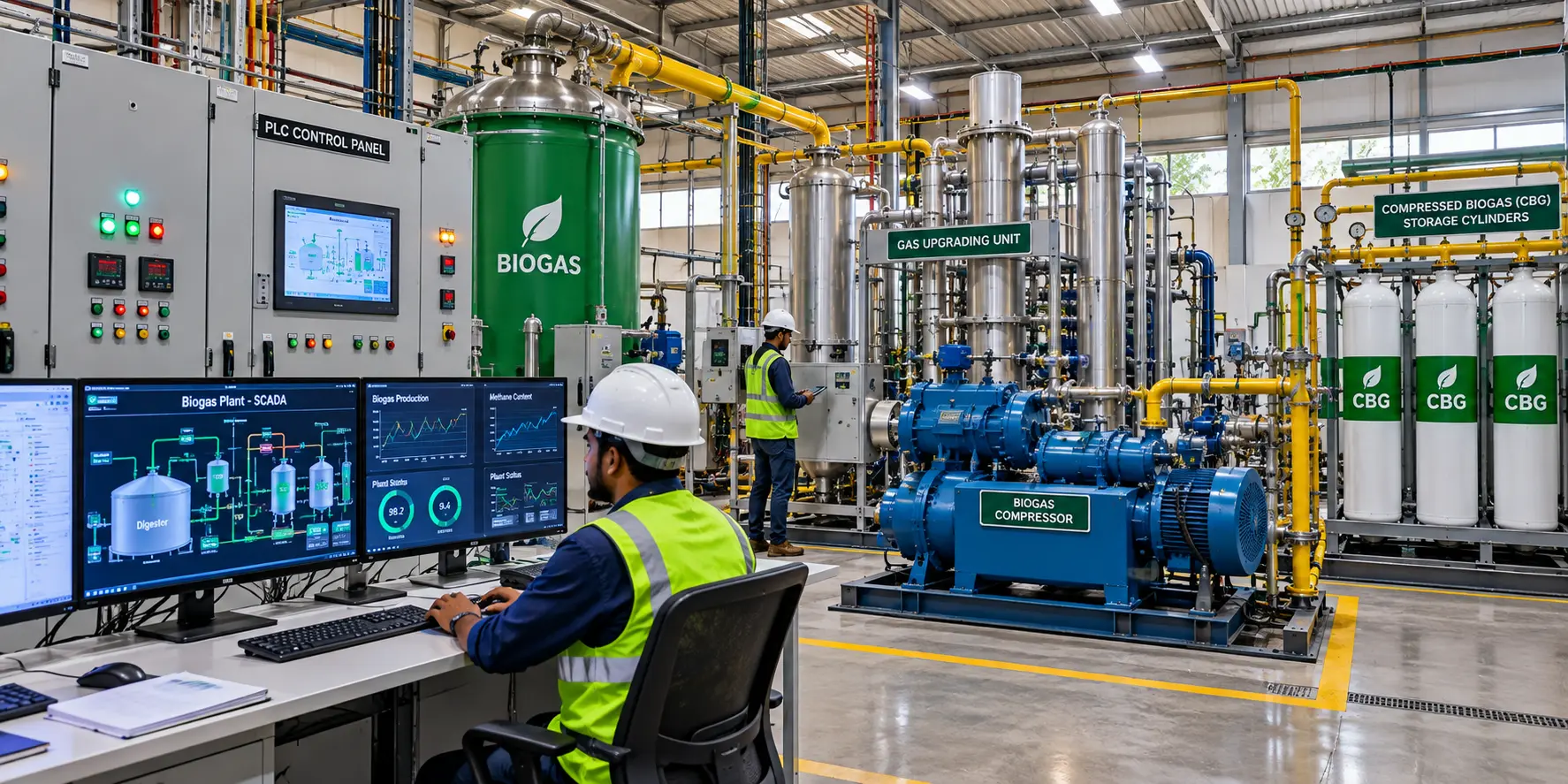
Accounts for 8–12% of total cost. Includes PLC/SCADA system, field instrumentation, MCC panels, HT/LT electrical works, CCTV and remote monitoring. Digital controls are not a luxury — they directly determine plant availability and gas recovery visibility.
Working Capital & Commissioning
Accounts for 5–8% of total cost. Covers feedstock for biological start-up, consumables, utilities during commissioning, performance trial costs, operator training and initial O&M spares.
Biogas Plant Cost in India by Capacity — Investment Scale Overview
Commercial CBG plant investment varies significantly based on capacity, feedstock type, site conditions, and delivery model. The capacity ranges below reflect common commercial scales seen under the SATAT scheme. A project-specific feasibility study is required to arrive at an accurate budget for your site.
- Small Commercial (5–8 TPD feedstock): Produces approximately 0.5–1.0 TPD CBG — an entry-level scale suited for first-project investors with a concentrated local feedstock base.
- Mid Commercial (10–15 TPD feedstock): Produces approximately 1.5–3.0 TPD CBG — the most common starting scale for first commercial SATAT plants with proven financing pathways.
- Standard SATAT Scale (15–30 TPD feedstock): Produces approximately 3.0–6.0 TPD CBG — a well-established scale with strong offtake, bank financing, and operational reference support.
- Large Commercial (50–100+ TPD feedstock): Produces 8–20+ TPD CBG — suited for large agri-clusters, industrial waste sources, or multi-feedstock integrated projects with scale economics.
Engineered solutions with performance guarantees always outperform unengineered alternatives over the plant's operating life — even when the headline capital cost appears lower at the outset. For a detailed sizing guide, read our article on 1000 cubic metre biogas plant cost and sizing.
The Hidden Biogas Plant Cost in India Most Investors Miss — Feedstock Logistics
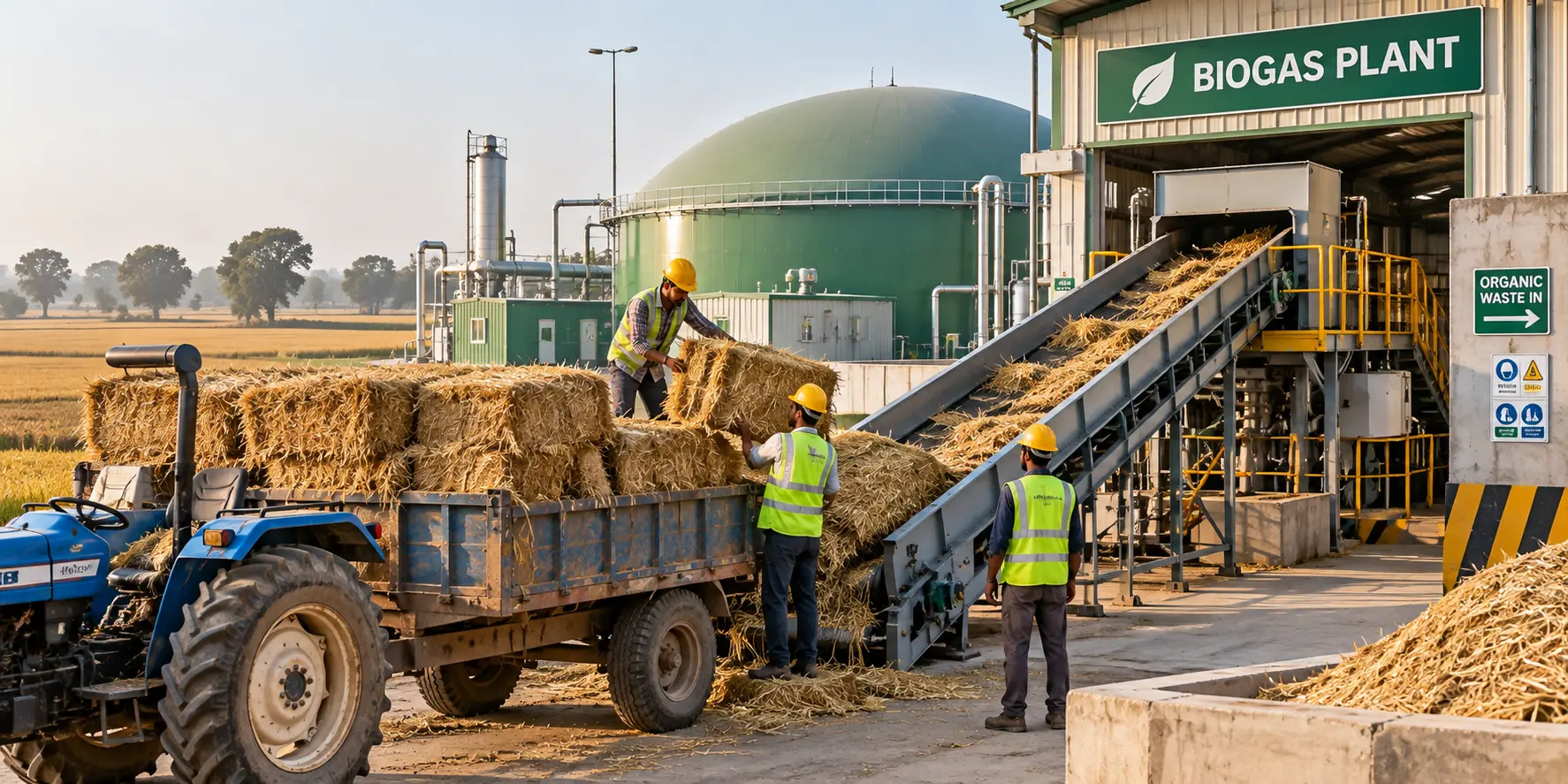
The biggest risk in CBG investment is not equipment cost — it is feedstock availability and logistics cost. In fact, feedstock logistics often affects biogas plant cost in India more than equipment does. Many investors see agricultural waste in their region and assume it is free and guaranteed. In practice, four factors significantly affect the real delivered cost of your feedstock and the commercial viability of the plant.
- Seasonal availability: Agricultural waste may only be available 3–4 months per year, requiring storage infrastructure and planned working capital to bridge the gap.
- Competing use: The same straw that feeds your biogas plant could go to cattle feed, paper mills or brick kilns — creating supply competition and upward price pressure.
- Collection radius: A wider collection radius adds significant logistics cost per tonne — directly affecting your operating economics and overall project returns.
- Storage losses: Biomass stored outdoors or improperly can lose 10–25% of its methane potential before reaching the digester inlet.
Tridanta's feedstock-first engineering approach requires the feed envelope to be defined, tested, and contracted before plant capacity is frozen or performance guarantees are signed. This protects investors from building a plant that cannot be reliably fed at the capacity it was designed for. Read more about our feedstock evaluation and testing process.
In a 1,000-acre agricultural zone assessment, Hybrid Napier grass delivered 6.4 TPD CBG from 365 TPD of feedstock. Sugarcane residues — theoretically abundant in the same zone — delivered only 2.6 TPD CBG once competing use, seasonality and logistics were factored in. Theoretical biomass is not bankable feedstock.
Biogas Plant Cost and Profit — What Is the ROI?
A well-designed CBG plant under the SATAT scheme can deliver strong and predictable returns. Revenue comes from three sources — and each must be assessed against your specific site, feedstock and operating conditions. For a full profitability breakdown, read our detailed guide on biogas plant cost and profit in India.
- CBG Sales: Sold to Oil Marketing Companies at the government-notified SATAT rate, or directly to industries and CGD networks at prevailing market rates.
- Organic Fertiliser (FOM/LFOM): Digestate processed into certified organic fertiliser and sold at competitive market rates to the agricultural sector.
- Carbon Credits: CBG qualifies for carbon offset credits under voluntary and compliance carbon frameworks, providing a third revenue stream.
At a standard commercial scale, a well-operated CBG plant under the SATAT scheme can generate strong and predictable monthly revenue with healthy operating margins. Payback periods and returns are project-specific and depend on feedstock cost, financing structure, and operational efficiency. A detailed DPR is required before any investment decision is finalised.
Financial projections must be grounded in real, site-specific feedstock data — not national averages or theoretical biomass estimates. Book a feasibility-first project consultation with Tridanta.
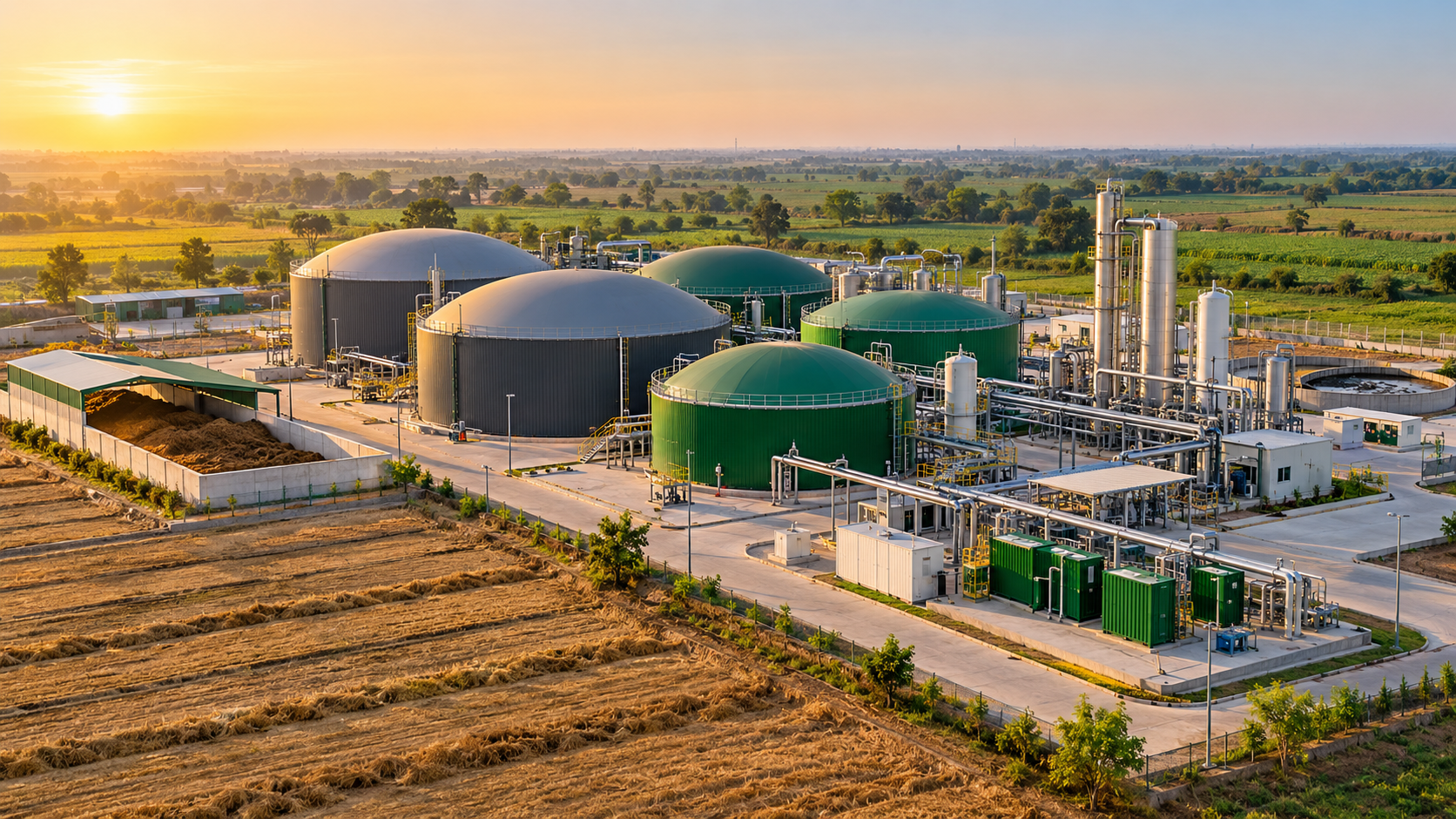
How a Biogas Plant Is Built — 8-Stage Delivery Process
Understanding the delivery process helps investors make sense of where costs occur and why timelines matter. Tridanta delivers CBG plants across 8 structured stages under both EPCM and LSTK delivery models. Each stage has a direct impact on the quality, reliability and overall performance of the final plant.
Feasibility & Feed
Feedstock mapping, technology selection, site assessment and financial modelling — completed before any design is frozen.
Detailed Engineering
PFD/P&ID development, plant layout, civil design, electrical and instrumentation design.
Procurement
Vendor qualification, technical bid evaluation, inspection and expediting.
Construction
Civil works, equipment erection, piping, electrical and instrumentation installation with QA/QC and HSE oversight.
Commissioning
Mechanical completion, biological start-up, feed ramp-up and stability period management.
PGTR
Measured verification of CBG output, recovery, product quality, utility consumption and plant availability against the contracted feed envelope.
Handover
Operator training, SOP documentation, spares handover and complete project documentation package.
Lifecycle Support
O&M contracts, remote diagnostics, seasonal performance optimisation and long-term asset management.
The PGTR stage is particularly important — acceptance is only declared after the plant demonstrates actual performance against measured inputs. This protects investors from accepting a plant that has not proven its commercial output.
EPCM vs LSTK — Which Contract Model Is Right for Your Project?
The choice of delivery model affects both your total project cost and your risk exposure. Tridanta offers both models through a single integrated engineering and execution platform.
EPCM — Owner-Side Integration
Tridanta leads engineering, procurement management, construction management, QA/QC, HSE, commissioning and performance integration while the owner retains direct commercial contracts with equipment suppliers and civil contractors. The owner benefits from full cost visibility and retains any procurement savings. Best suited for experienced developers with in-house teams who want cost control and package-level commercial transparency.
LSTK — Single-Point Accountability
Tridanta assumes integrated responsibility for design, procurement, construction, commissioning and performance obligations against a defined feedstock and battery-limit basis. Fixed price agreed upfront. Owner transfers execution risk to Tridanta. Best suited for first-time CBG investors, lenders requiring a turnkey structure, or projects where schedule and cost certainty are critical. See the full EPCM vs LSTK comparison on our Solutions page.
Why Feedstock-First Engineering Reduces Your Cost Risk
The most common cause of CBG plant underperformance in India is not poor equipment — it is a mismatch between the plant design and the actual feedstock delivered. When a plant is designed for a theoretical feedstock that turns out to be unavailable, seasonal, or of lower quality than expected, the consequences are significant.
- Lower methane yield than projected — reducing CBG output and revenue.
- Biological instability, foaming, or digester upset — causing unplanned downtime.
- Higher-than-projected utility consumption — compressing operating margins.
- Unplanned maintenance costs — eroding the financial case for the project.
Tridanta's feedstock-first process defines the contractual feed envelope — availability, quality, logistics, and blend windows — before any plant capacity or performance guarantee is frozen. This makes both the engineering and the investor's business case more robust and bankable.
Government Support for Biogas Plants in India
India's policy environment for CBG projects is one of the strongest in the clean energy sector. Three layers of government support reduce investment risk and improve the financial profile of well-structured projects.
SATAT Scheme
Launched by MoPNG. Provides assured CBG offtake by IOC, BPCL and HPCL at a government-notified rate. Letter of Intent (LOI) issued to qualifying plants before construction begins. Covers all feedstock types — agricultural residues, cattle dung, municipal solid waste and industrial organic waste.
Priority Sector Lending
CBG plants qualify as renewable energy projects under RBI's priority sector lending guidelines, enabling access to bank finance at concessional interest rates.
State-Level Subsidies
Several state governments — including Haryana, Punjab, Gujarat and Maharashtra — offer additional capital subsidies or incentives for agricultural waste-based CBG plants. Check current state-specific policies before finalising your project DPR.
Digestate Classification
Digestate qualifies for registration as Fermented Organic Manure (FOM) under the Fertiliser Control Order — enabling legal and commercial sale as certified organic fertiliser to the agricultural sector.
For a complete guide to the CBG policy landscape, read our article on biogas plant development in India under the SATAT scheme.
Completed CBG Projects — Real-World Reference
Tridanta's delivery platform carries 64 project references across India and internationally — 48 in India and 16 international installations. Selected references demonstrate delivery across multiple feedstock types, digestion technologies, geographies, and project scales.
- 15.3 TPD BioCNG — Ambala, Haryana: Paddy/rice straw and cow manure; Continuous Plug Flow dry digestion; technology association with Arciplug, Finland; gas production has commenced.
- 6 TPD CBG — Dhansri / Jansath, Muzaffarnagar: Agricultural/organic feed; recent dry-digestion EPC and commissioning reference demonstrating package integration and start-up capability.
- 6 TPD CBG — Gulbarga, Karnataka: CSTR-based wet digestion; organic feedstock — demonstrates complementary wet-digestion process capability.
- CBG/Biogas — Thrissur, Kerala: Dry digestion of municipal organics; statutory compliance across a complex regulatory environment.
- Biogas — Jagruti Sugar Mill, Latur: High-COD industrial spent wash anaerobic digestion and gas recovery reference.
How to Start Your CBG Plant Project
Getting a CBG plant from concept to operation requires a structured sequence. Rushing any early stage increases both cost and risk later in the project lifecycle.
Verify Your Feedstock
Not theoretical — contractually securable, with confirmed availability, quality, logistics cost and seasonal profile.
Run a Feasibility Study
Feedstock-based feasibility to determine the right plant capacity, technology route and investment scale.
Obtain SATAT LOI
Apply to the relevant Oil Marketing Company for offtake assurance under the SATAT scheme before committing to construction.
Engage an Engineering Partner
Select an EPCM or LSTK partner with proven CBG project references and performance guarantee delivery capability.
Arrange Finance
Prepare a DPR for bank lending or equity investment under priority sector lending guidelines.
Execute with Performance Guarantee
Ensure acceptance is based on measured output — CBG quantity, product quality, methane recovery and plant availability — not just mechanical completion.
Also read: Biogas plant setup cost — what investors need to know before starting.
Frequently Asked Questions
What determines biogas plant cost in India?
Commercial CBG plant investment varies significantly depending on plant capacity (TPD), feedstock type, site conditions, technology route and delivery model. A project-specific feasibility study anchored to real feedstock data is required to arrive at an accurate and bankable budget. Request a feasibility study for your site.
How much CBG does a biogas plant produce per tonne of feedstock?
CBG yield depends on feedstock type and quality. Paddy straw and cow manure combined typically yield 80–120 Nm³ of raw biogas per tonne, which after upgrading produces approximately 50–75 Nm³ of CBG per tonne of wet feedstock. A detailed BMP (Biochemical Methane Potential) test is required for accurate project sizing.
Is a biogas plant a profitable investment in India?
Yes. Under the SATAT scheme, CBG plants can deliver strong returns through assured offtake, organic fertiliser revenue and carbon credits. Profitability depends on securing low-cost feedstock, selecting the right technology route, and maintaining high plant availability. A detailed DPR with site-specific data is required to model actual returns for your project.
What feedstock is best for a biogas plant in India?
The best feedstock is the one that is reliably available, contractually securable, and cost-effective to deliver to your site — not the one with the highest theoretical methane potential. Paddy straw, cattle dung, sugarcane press mud, food waste and municipal organics are all viable depending on geography, availability and logistics.
What is the difference between a biogas plant and a CBG/BioCNG plant?
A basic biogas plant produces raw biogas used on-site for cooking or power generation. A CBG/BioCNG plant adds gas upgrading and compression to produce pipeline-quality compressed gas that can be dispensed, transported or sold to CGD networks and industries. CBG plants require higher investment but offer commercial-scale revenue through the SATAT scheme.
How long does it take to commission a biogas plant in India?
From groundbreaking to gas production, a typical mid-scale CBG plant takes 12–18 months. Biological start-up and ramp-up to stable commercial production adds a further 3–4 months. Early feedstock contracting and statutory approvals significantly affect the overall project timeline.
What government support is available for biogas plants in India?
The SATAT scheme provides assured CBG offtake by Oil Marketing Companies at a government-notified rate. Plants also qualify for priority sector lending from banks at concessional rates. Several states offer additional capital subsidies. Digestate qualifies for registration as Fermented Organic Manure (FOM) under the Fertiliser Control Order.
What is PGTR in a CBG plant?
PGTR stands for Performance Guarantee Test Run. It is a structured process to demonstrate that the plant achieves its contracted output — CBG quantity, methane purity, methane recovery, utility consumption and plant availability — against the defined feedstock envelope. Acceptance is declared only after the PGTR is completed and documented. It protects investors from accepting a plant that has not proven its commercial performance.
Turning waste into clean energy requires a complete project view.
From feedstock strategy to engineering, execution and performance assurance, every stage matters. To get an accurate biogas plant cost in India for your site, share your feedstock, site and offtake context with Tridanta — our engineering team will respond with a feasibility-first perspective grounded in real project data. Discuss Your Project with Tridanta →

