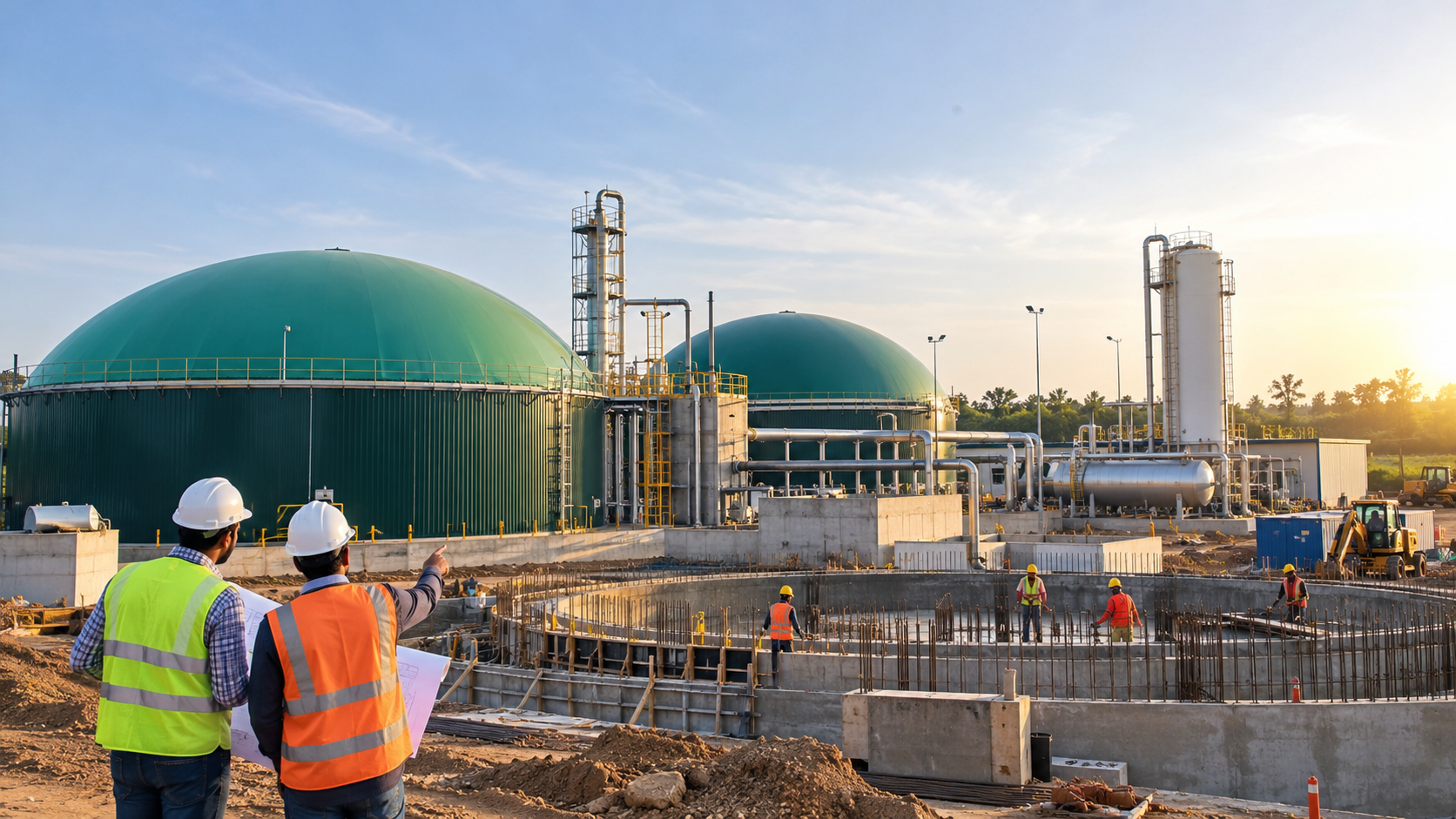
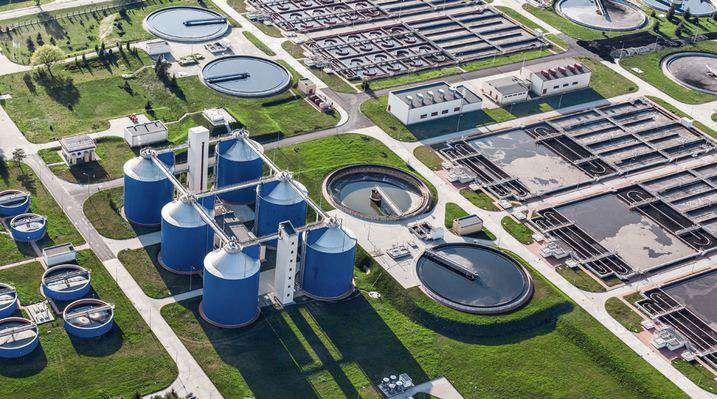
Tridanta Bioenergy & Clean Gas Private Limited operates as a CBG company in NCR — delivering Compressed Biogas projects across Noida, Greater Noida, Ghaziabad, Faridabad, and Gurgaon through an engineering-led, feedstock-first approach. The National Capital Region is currently one of the most active CBG markets in India: all five cities have either signed agreements, active procurement, or plants under construction. Noida Authority has signed a Letter of Intent with IGL for a 300 TPD plant. Greater Noida is procuring a separate 300 TPD landfill plant. Ghaziabad has a 15-year BOT contract signed for a sewage-fed bio-CNG plant. Gurgaon is at design-review stage. Faridabad is re-tendering an existing but idle biomethanation plant. For any organisation evaluating a CBG project partner in this region, this guide covers what to look for, which schemes apply, how to evaluate any operator, and what Tridanta delivers on the ground.
What a CBG Company in NCR Does — End to End
Compressed Biogas is produced by breaking down organic waste in sealed anaerobic digesters. Raw biogas — roughly 55–70% methane — is then scrubbed to remove carbon dioxide and moisture. What remains is CBG: over 90% methane, chemically near-identical to CNG, usable in the same vehicles, the same industrial burners, and the same city gas distribution pipelines that IGL operates across NCR.
A full-service CBG company covers five responsibilities — and the difference between a plant that runs for twenty years and one that stalls within six months almost always comes down to how tightly each is contracted before construction begins.
Feedstock Contracting
A signed supply agreement — not an MoU — with daily tonnage commitments, waste segregation quality standards, and a penalty clause for shortfall. Tridanta's feedstock-first engineering anchors plant sizing to the documented waste stream, not a theoretical available quantum.
Plant Engineering & EPC
Process engineering, technology route selection, and performance modelling before any civil or procurement work begins. Tridanta delivers both EPCM and LSTK contract structures depending on the client's procurement model and risk appetite.
Production & Gas Quality
Running digestion and scrubbing output to BIS-grade CBG. SCADA, historian logging, and remote diagnostics provide the audit-ready operational data that OMC offtakers and government clients require for performance verification.
SATAT Offtake Integration
Signed purchase agreements with IGL, BPCL, IOCL, or HPCL under the SATAT scheme. The CBG Blending Obligation — 1% in FY26, 3% in FY27, 5% from FY29 — makes NCR-produced CBG a statutory purchase requirement for city gas distributors.
By-Product Revenue
Fermented organic manure (FOM) and bio-slurry form the second revenue stream. FOM offtake materially improves project IRR and is increasingly mandated under state agricultural department frameworks across UP and Haryana.
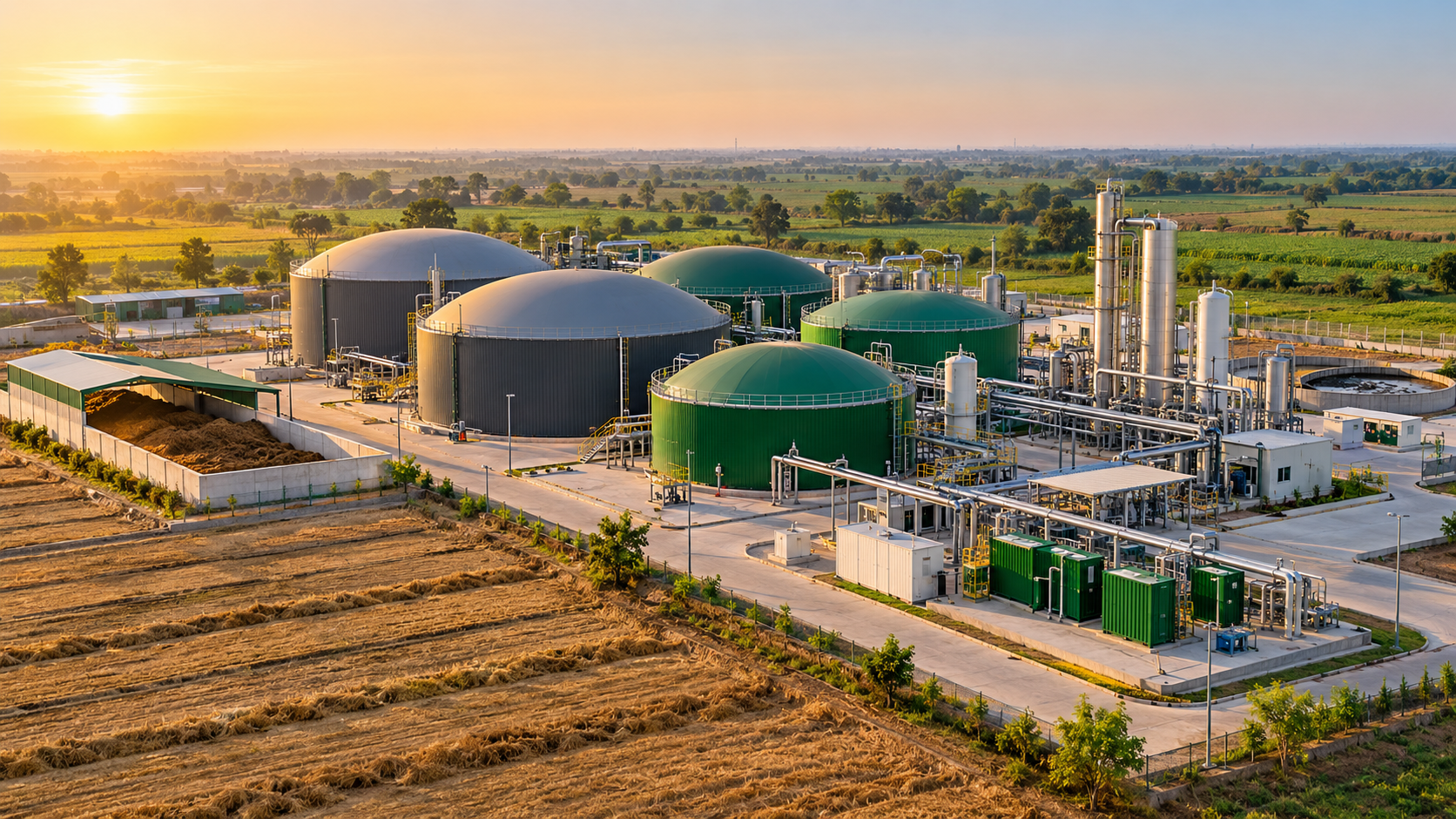
NCR CBG Project Status — City by City (October 2026)
The table below summarises the current state of government-initiated CBG projects across the five main NCR cities. These are the publicly announced projects; private-sector projects in the same geographies are additional.
| City | Capacity | Feedstock | Status |
|---|---|---|---|
| Noida | 300 TPD + 100–120 TPD (horticulture) | MSW, horticulture waste | LoI signed — Noida Authority + IGL |
| Greater Noida | 300 TPD | Municipal solid waste (Astauli landfill) | Under procurement — GNIDA |
| Ghaziabad | Not disclosed | Sewage sludge — 70 MLD STP, Dundaheda | Shareholders agreement signed April 2026 — WABAG + PEAK JV |
| Gurgaon | 150–200 TPD | MSW — Bandhwari landfill | Design review stage — MCG |
| Faridabad | 250 kg/day bio-CNG | Kitchen & organic waste, Sector 13 | Idle — MCF re-tendering operations |
Sources: IamRenew — Noida IGL project · BioEnergyTimes — Greater Noida Astauli · Construction World — Ghaziabad WABAG · BioEnergyTimes — MCG Gurgaon · The Tribune — Faridabad
Why Faridabad Matters for Every NCR Project
Faridabad's Sector 13 biomethanation plant was technically sound — built with Indian Oil Corporation's R&D support, designed to produce 250 kg of bio-CNG per day. It became non-functional within months of commissioning in January 2020 because the waste collection agency could not maintain five tonnes of daily organic feedstock supply. There was no contractual penalty mechanism to enforce supply. MCF is now re-tendering operations. That sequence — capable plant, absent feedstock agreement, idle asset — is the single most useful reference when evaluating any CBG project risk in NCR.
Tridanta's completed NCR-adjacent projects carry real commissioning and performance data: 15.3 TPD BioCNG in Ambala, Haryana (paddy straw feedstock, production commenced) and 6 TPD CBG in Muzaffarnagar, UP (agricultural organic feed, UPPCB compliant). Both references are available with completion certificates for due diligence and tender qualification.
Government Schemes That Make NCR CBG Projects Financially Viable
Gas revenue alone rarely makes a CBG project bankable at smaller scales. The policy framework — demand mandates, capital support, and infrastructure funding — is what closes the gap. Key schemes relevant to NCR are listed below. Source: Drishti IAS, July 2026
- SATAT (Sustainable Alternative Towards Affordable Transportation): Launched in 2018, SATAT invites entrepreneurs to register CBG plants and supply gas to OMCs under assured offtake at formula pricing. The scheme provides the commercial foundation for Noida's and Ghaziabad's projects.
- CBG Blending Obligation: City gas distributors — including IGL, which operates across NCR — must purchase and blend CBG into CNG and domestic PNG. Mandatory trajectory: 1% in FY26, 3% in FY27, 4% in FY28, 5% from FY29 onwards. This is statutory demand, not discretionary procurement.
- GOBARdhan Yojana: Central assistance for community or cluster-based biogas plants. Applicable to smaller agricultural-residue-fed projects in NCR's rural periphery — western UP and Haryana districts.
- Biomass Aggregation Machinery Scheme: Central outlay to fund machinery for agricultural residue collection, storage, and transport. Directly applicable to UP-side NCR projects using paddy straw or press mud from Hapur, Bulandshahr, and Muzaffarnagar districts.
- Pipeline Connectivity Funding: Central allocation to connect CBG plants to gas networks. Reduces infrastructure capital burden for NCR plants connecting into IGL's distribution system.
- SBM-Urban 2.0: Funds biomethanation and CBG plants that process municipal solid waste. Directly relevant to the landfill-based projects in Noida, Greater Noida, and Gurgaon where municipal bodies provide the feedstock.
Tridanta's CBG EPC Services in Noida, Ghaziabad, and Gurgaon
Tridanta delivers CBG plant engineering, procurement, and construction across all five NCR cities — under both EPCM (owner-managed) and LSTK (single-point turnkey) contract structures. Each city has a different regulatory jurisdiction, different feedstock profile, and a different procurement environment. Tridanta's NCR capability covers all of them.
- Noida and Greater Noida (UPPCB jurisdiction): MSW-to-CBG and sewage sludge digestion projects, GNIDA and NMCG framework compliance, SATAT-aligned offtake integration with IGL. Tridanta's Muzaffarnagar reference is the closest comparable completed project. See reference →
- Ghaziabad (UPPCB jurisdiction): Sewage sludge and agricultural residue from Hapur and Bulandshahr districts. Nagar Nigam procurement compliance. BOT and PPP structuring for STP-based projects.
- Gurgaon (HSPCB jurisdiction): MSW and food waste co-digestion for MCG-initiated projects. LSTK delivery including HSPCB statutory clearances and PESO approvals for gas storage and compression.
- Faridabad (HSPCB jurisdiction): Municipal waste characterisation, technology selection for mixed urban-organic feedstock, LSTK commissioning with performance-guarantee test run documentation for re-tendered or new government projects.
For project qualification, bid preparation, or technical due diligence, Tridanta can provide feedstock analysis, technology route recommendation, preliminary financial modelling, and full compliance documentation within the required timeline. Share your project brief →
How to Evaluate a CBG Project Partner in NCR
Four questions to ask any operator before signing a contract:
- Is the feedstock agreement signed — not an MoU? An MoU is an intention. A supply contract with daily tonnage, quality standards, and a shortfall penalty is the only document that protects plant utilisation. The Faridabad failure demonstrates exactly what happens when this distinction is ignored.
- Which buyer has signed your gas offtake agreement? "We are aligned with IGL" is not the same as a signed purchase agreement at a disclosed price formula. The blending mandate means buyers exist nationally — the question is whether your specific plant has a committed buyer with a contract in place.
- What are your PCB clearance, PESO approval, and PGTR references? UPPCB or HSPCB consent, PESO approval for compression and storage, and a Performance Guarantee Test Run record from a comparable-scale plant. Without a PGTR record, there is no verified evidence that a plant hits its rated output under contractual feedstock conditions.
- What is the O&M commitment structure? CBG plants require 15–20 years of consistent operation to deliver acceptable returns. An operator who builds and hands over without a structured O&M agreement transfers the operational complexity to a client who typically has no in-house CBG expertise.
Tridanta's 64 project references across India and internationally include BioCNG plants at 15.3 TPD (Ambala, Haryana — paddy straw, production commenced), 6 TPD (Muzaffarnagar, UP — agricultural organic feed, UPPCB compliant), and a municipal organic waste reference in Thrissur, Kerala. Completion certificates, performance data, and technology credentials are available for government tender qualification and due diligence under NDA. Request references →
Frequently Asked Questions
What does CBG stand for and how is it different from CNG?
CBG stands for Compressed Biogas — produced from organic waste through anaerobic digestion, then purified and compressed to over 90% methane. CNG is fossil natural gas. Both perform identically in vehicles and pipelines, but CBG qualifies toward India's renewable energy and waste-management targets. City gas distributors like IGL are legally required to blend CBG into their network — an obligation that does not apply to fossil CNG.
Which NCR cities have CBG projects and at what stage?
Noida has a 300 TPD MSW plant under LoI with IGL. Greater Noida has a 300 TPD landfill plant under active procurement. Ghaziabad has a sewage-fed BOT plant with shareholders agreement signed in April 2026 — construction stage. Gurgaon is at design-review stage for a 150–200 TPD plant; no tender has been issued yet. Faridabad has an existing 250 kg/day bio-CNG plant that is currently idle and being re-tendered by MCF.
What compliance approvals does a CBG plant need in NCR?
Noida, Greater Noida, and Ghaziabad plants require UPPCB consent to establish and operate. Gurgaon and Faridabad plants require HSPCB clearance. All plants additionally need PESO approval for gas storage and compression, fire NOC, factory licence, and BIS-grade gas quality certification before any commercial sale to an OMC or city gas distributor. Tridanta manages the full compliance stack across both regulatory jurisdictions.
NCR has the feedstock, the policy framework, and active municipal procurement. What most projects are missing is the right operator.
Faridabad showed what happens when feedstock risk is ignored at the contracting stage. Noida and Ghaziabad are showing what properly structured projects look like. If you are evaluating a CBG project in NCR — as a municipal body, a private investor, or a feedstock owner — share the brief with Tridanta's team. We will respond with a feedstock-first feasibility perspective, technology route recommendation, and preliminary financial model before any EPC commitment is made. Discuss Your NCR CBG Project with Tridanta →