
Finding the right EPC company of CBG plants is the first serious decision for any biogas investor across the National Capital Region. Delhi, Noida, Gurugram, Faridabad and Ghaziabad each sit on a different feedstock base, and your contractor has to understand that local mix, not just build to a standard drawing. This guide covers what a CBG EPC partner delivers, how coverage differs city by city, the EPC versus LSTK contracting choice, and the checks every investor should run before signing a contract. The core fundamentals of a strong EPC partnership stay the same wherever your NCR site actually sits.
What Is an EPC Company of CBG Plants?
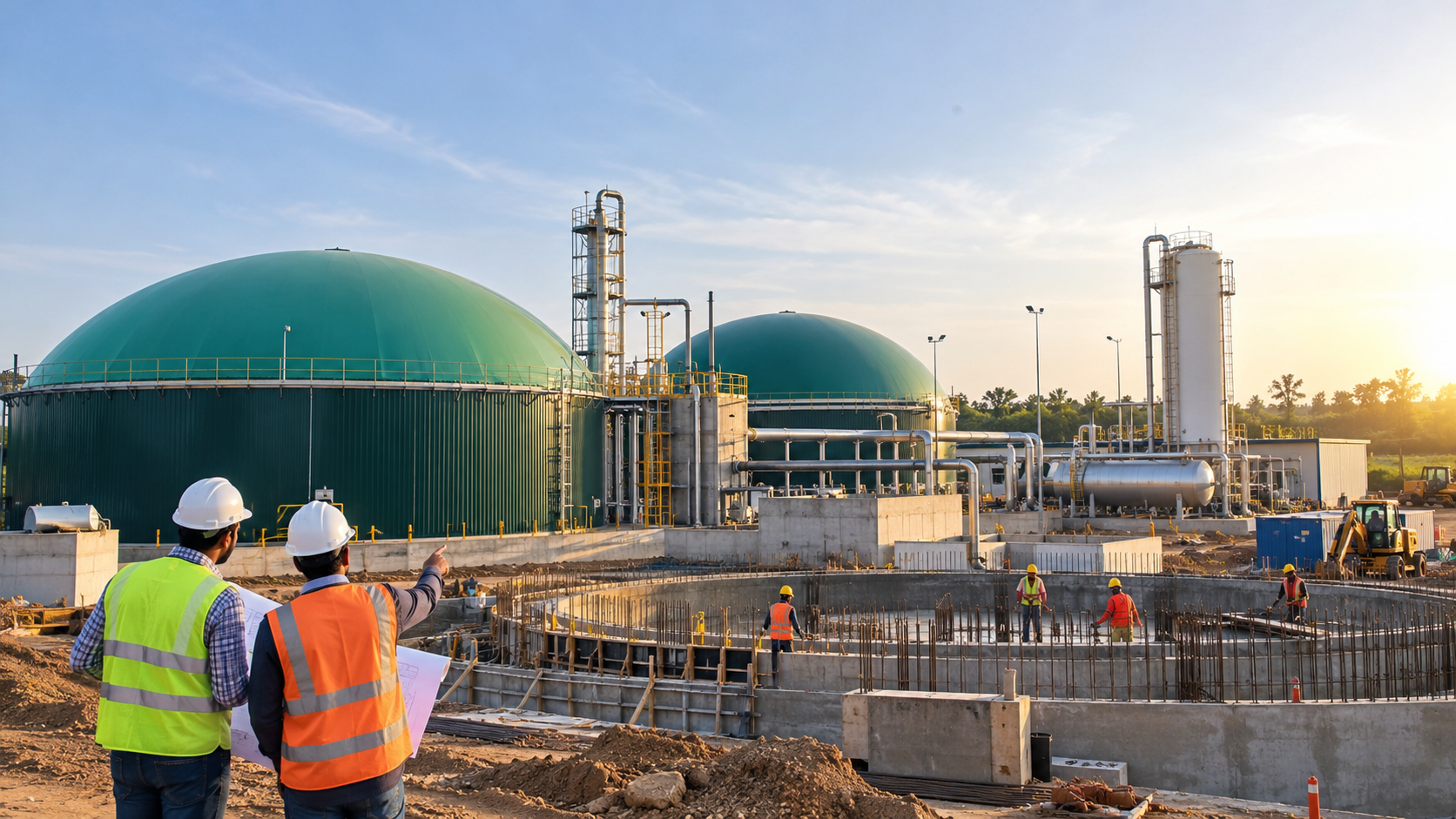
This type of contractor handles Engineering, Procurement and Construction — turning a feasibility study into a working Compressed Biogas plant. That means process design, digester sizing, equipment sourcing, civil and electrical construction, and commissioning to a contracted gas output. A capable partner stays accountable for actual performance, not just for finishing construction on schedule.
- Engineering — process design, digester sizing, PFD/P&ID development, civil and electrical design.
- Procurement — vendor selection, equipment sourcing, technical bid evaluation and quality inspection.
- Construction — civil works, equipment erection, piping and electrical installation.
- Commissioning — biological start-up, feed ramp-up, and measured performance verification.
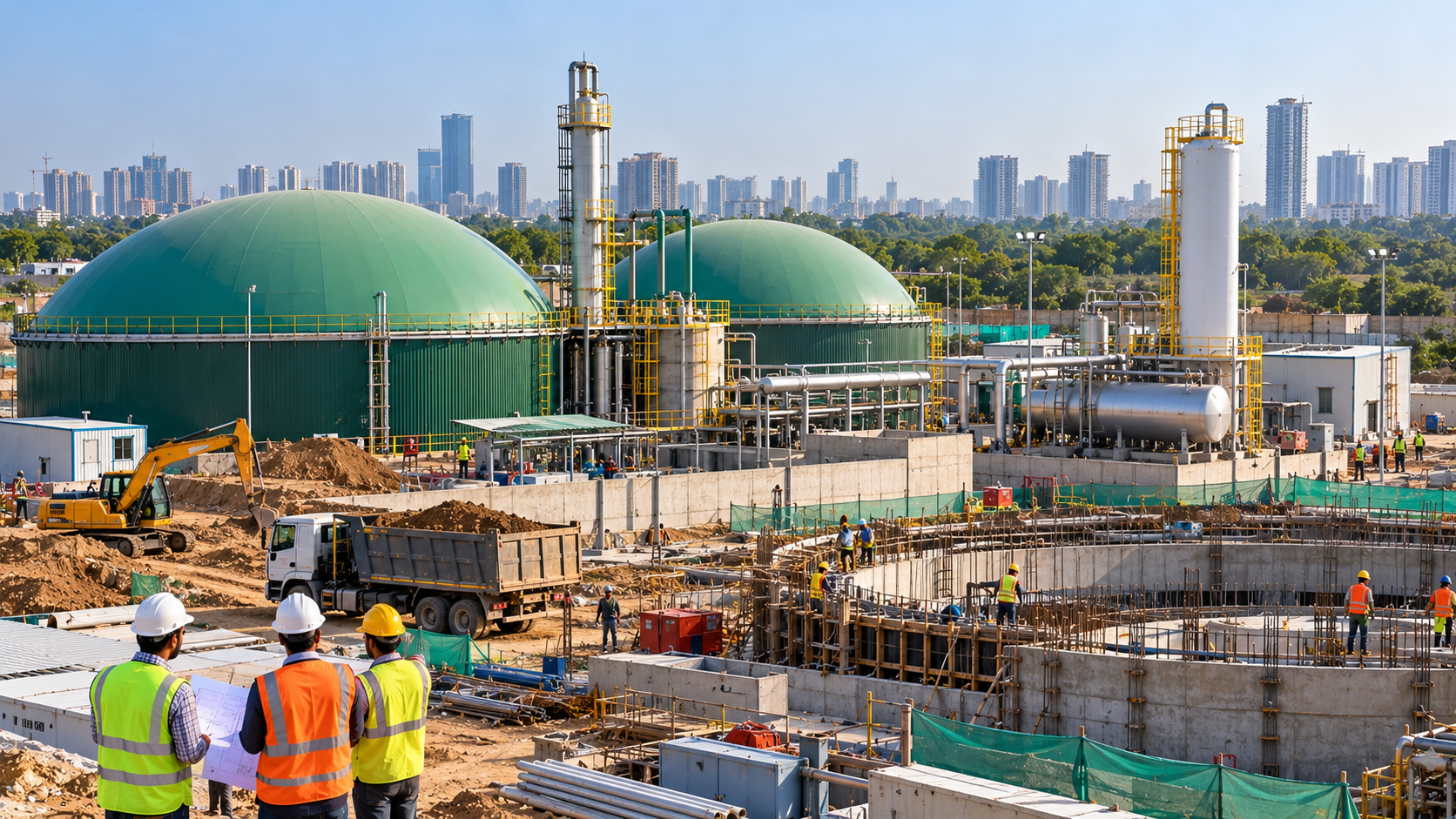
A good CBG EPC contractor ties acceptance to a measured Performance Guarantee Test Run, not just mechanical completion — that's what protects your investment once the plant is actually running.
Why NCR Needs a Specialised Biogas EPC Partner
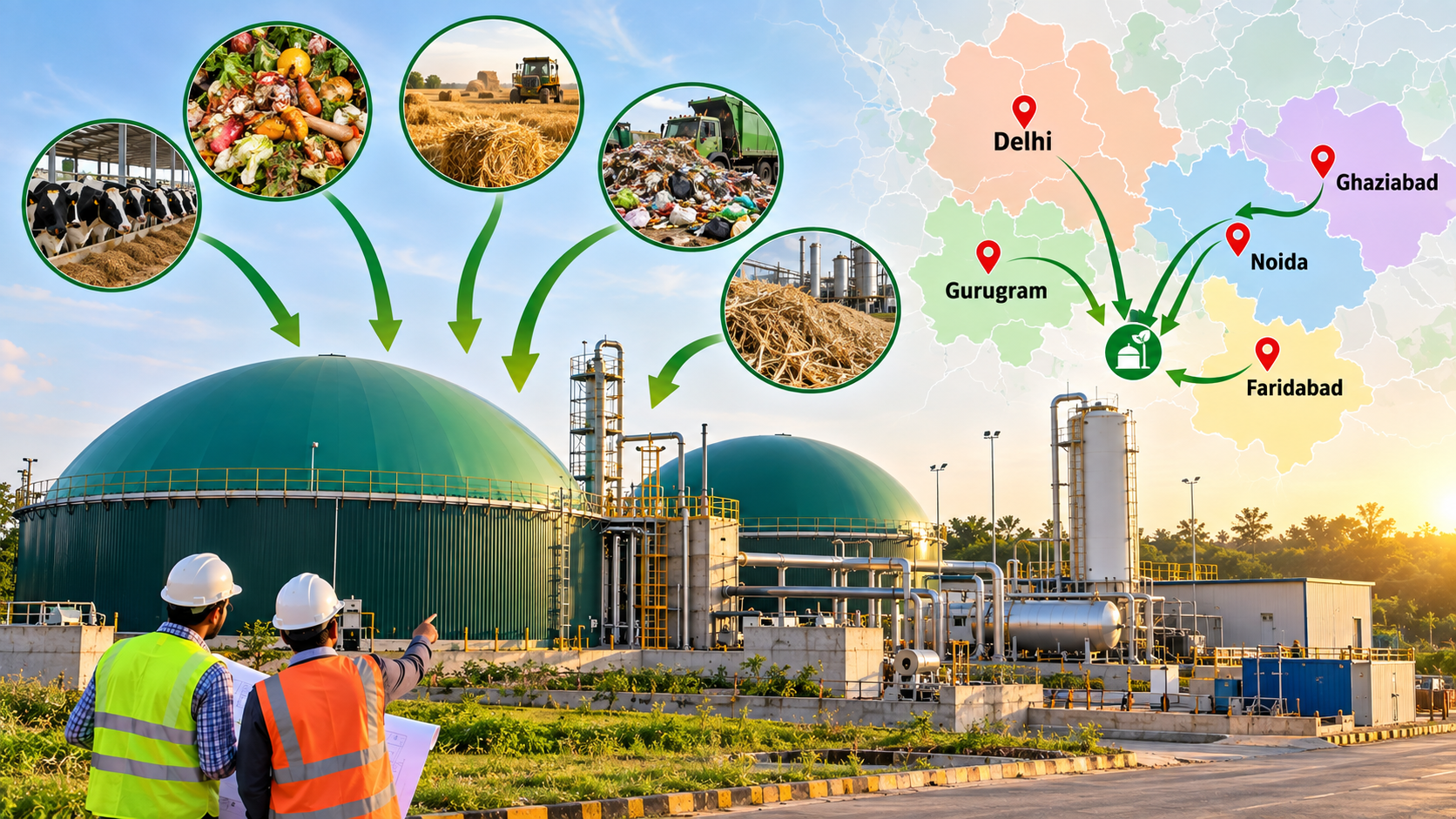
NCR's feedstock is genuinely mixed — agricultural residue, dairy waste, municipal organics, and food waste from a large hospitality sector. A generic biogas EPC contractor built for one feedstock type elsewhere often underperforms here, because NCR sites frequently need a hybrid digestion approach tuned to more than one waste stream at once.
- Agricultural residue — paddy straw and crop waste from Haryana and western UP districts.
- Dairy and cattle waste — a steady, low-seasonality supply from NCR's dairy colonies and farms.
- Municipal solid waste — organic fraction from Delhi-NCR's urban centres, relevant for waste-to-energy CBG projects.
- Food and hospitality waste — from NCR's dense hotel, restaurant and institutional catering sector.
NCR also sits close to major City Gas Distribution networks and Oil Marketing Company depots under the SATAT scheme, which shortens the distance between plant output and paying offtake. That proximity matters commercially — a shorter, cheaper evacuation route to an existing gas grid directly improves project economics compared with a similarly sized plant located further from CGD infrastructure.
EPC Company of CBG Plants in NCR: City-Wise Coverage
Coverage needs differ by city even within NCR, so a serious CBG EPC contractor tailors its approach location by location rather than applying one template everywhere. The table below summarises the dominant feedstock and site considerations typically relevant in each major NCR city, based on common project patterns seen across the region.
| City / Region | Dominant Feedstock | Key EPC Consideration |
|---|---|---|
| Delhi | Municipal solid waste, food waste | Urban site access and waste segregation logistics |
| Noida & Greater Noida | Food and institutional waste, MSW | Proximity to CGD network for CBG evacuation |
| Gurugram | Industrial and food waste | Land availability outside the core industrial belt |
| Faridabad | Agricultural residue, industrial waste | Mixed feedstock digestion design |
| Ghaziabad | Municipal organics, agricultural residue | Urban-rural feedstock blending |
An EPC Company of CBG Plants in Delhi usually prioritises urban site access and waste segregation logistics, since municipal solid waste and food waste dominate the city's feedstock mix. An EPC Company of CBG Plants in Noida more often works with food and institutional waste alongside easy proximity to CGD pipelines for faster CBG evacuation to market.
Whatever the city, the underlying question stays the same: has this contractor actually tested your feedstock, or is capacity based on assumed biomass? That single check matters more than any city-specific detail.
What a CBG EPC Partner Delivers for Your Project
Not every CBG EPC contractor covers the full delivery scope. Before signing, confirm your partner is genuinely responsible for feasibility and feed assessment, detailed engineering, procurement and construction, and commissioning with measured performance verification — not just one or two of these stages while subcontracting the rest without any real oversight.
Feasibility & Feed Assessment
Feedstock mapping, technology selection, site assessment and financial modelling, completed before any design work is frozen for your NCR site.
Detailed Engineering
PFD/P&ID development, plant layout, civil design, electrical and instrumentation design tailored to your feedstock mix and location.
Procurement & Construction
Vendor qualification, equipment sourcing, civil works, erection, piping and electrical installation, with QA/QC and HSE oversight throughout.
Commissioning & PGTR
Mechanical completion, biological start-up, feed ramp-up, and a measured Performance Guarantee Test Run before final acceptance.
Why Feedstock-First Engineering Matters
The most common cause of underperformance isn't poor equipment — it's a mismatch between plant design and the feedstock actually delivered. A feedstock-first EPC partner defines the contractual feed envelope — availability, quality, logistics and blend windows — before any capacity or performance guarantee is signed, which protects the investor's business case from day one.
EPC vs LSTK: Choosing the Right Model for Your NCR Project
EPC Model — Owner Retains Commercial Control
Under a pure EPC arrangement, the contractor delivers engineering, procurement and construction management, while the owner may hold direct commercial contracts with equipment suppliers and civil contractors. This gives the owner cost visibility and any procurement savings, and suits developers with an in-house team who want package-level transparency across their NCR project.
LSTK Model — Single-Point Accountability
An LSTK contractor takes integrated responsibility for design, procurement, construction, commissioning and performance obligations at a fixed price, against a defined feedstock and battery-limit basis. This suits first-time investors, lenders who require a turnkey structure, or projects where schedule and cost certainty matter more than procurement flexibility.
Compare EPCM and LSTK contract models in detail before finalising your NCR project structure — the right choice depends on your team's capacity and your lender's requirements.
What to Verify Before Hiring a CBG EPC Contractor
- Feedstock-first process — has the contractor actually tested and contracted your feedstock, or is capacity based on assumed biomass availability?
- Reference projects — does the contractor have operating plants with your feedstock type and digestion technology?
- Performance guarantee structure — is acceptance tied to a measured PGTR, or only to mechanical completion?
- Local execution capability — can the team mobilise across Delhi, Noida, Gurugram, Faridabad and Ghaziabad sites without heavy coordination delays?
Documentation and Compliance Support
A CBG EPC contractor should also handle environmental clearances and state-level approvals across Delhi, Haryana and Uttar Pradesh as part of the engineering scope. Read more CBG and biogas guides on financing and project economics.
Government Support for CBG Projects Across NCR
A CBG plant built through a qualified EPC route remains eligible for standard government support. The Ministry of New and Renewable Energy's National Bioenergy Programme provides Central Financial Assistance for eligible projects, while the SATAT scheme guarantees CBG offtake by Oil Marketing Companies at a notified rate.
- MNRE central financial assistance covers a share of eligible capital cost for qualifying waste-to-energy projects.
- SATAT offers assured CBG offtake by IOC, BPCL and HPCL under long-term agreements.
- CBG plants qualify for priority sector lending from banks at concessional interest rates.
- Digestate can be registered as Fermented Organic Manure (FOM) under the Fertiliser Control Order.
According to the Indian Biogas Association, sector investment interest keeps growing, making this a strong window to lock in EPC capacity early. See our project portfolio for reference installations across NCR.
Choose Your CBG EPC Partner on Delivery Capability, Not Price Alone
Across Delhi, Noida, Gurugram, Faridabad and Ghaziabad, the lowest EPC quote and the best-performing plant are rarely from the same contractor. Before you sign a CBG EPC contractor for your NCR project, verify their feedstock testing process, reference installations, and how strictly the contract ties acceptance to measured performance under a Performance Guarantee Test Run. That single check determines whether your plant hits its contracted output from day one, rather than spending its first two years catching up to a number it was never actually designed to reach. Discuss Your Project with Tridanta →
Frequently Asked Questions
What does an EPC company of CBG plants actually do?
It handles engineering, procurement, construction and commissioning —
taking a project from feasibility study to a running, performance-verified
plant, with accountability for actual gas output, not just finished
construction.
Which NCR cities have strong feedstock for CBG plants?
Delhi, Noida, Gurugram, Faridabad and Ghaziabad each have workable
feedstock — municipal, industrial, food, and agricultural residue from
nearby districts.
What's the difference between EPC and LSTK for a CBG project?
Under EPC, the owner retains direct supplier contracts and cost
visibility. Under LSTK, the contractor takes single-point accountability
for design, construction and performance at a fixed price.
How do I verify a CBG EPC contractor before signing?
Check feedstock testing, reference projects, whether acceptance ties to a
measured PGTR, and local execution capability in your NCR location.
How long does an EPC-built CBG plant take to commission?
A typical mid-scale CBG plant takes around 12–18 months from
groundbreaking to gas production, plus 3–4 months for biological start-up
and ramp-up to stable commercial output.

